


The landscape of software architecture documentation is undergoing a radical transformation. Historically, creating system diagrams was a tedious process involving drag-and-drop interfaces, manual layout adjustments, and the constant risk of documentation drift—where the visual diagram no longer matches the actual running code.
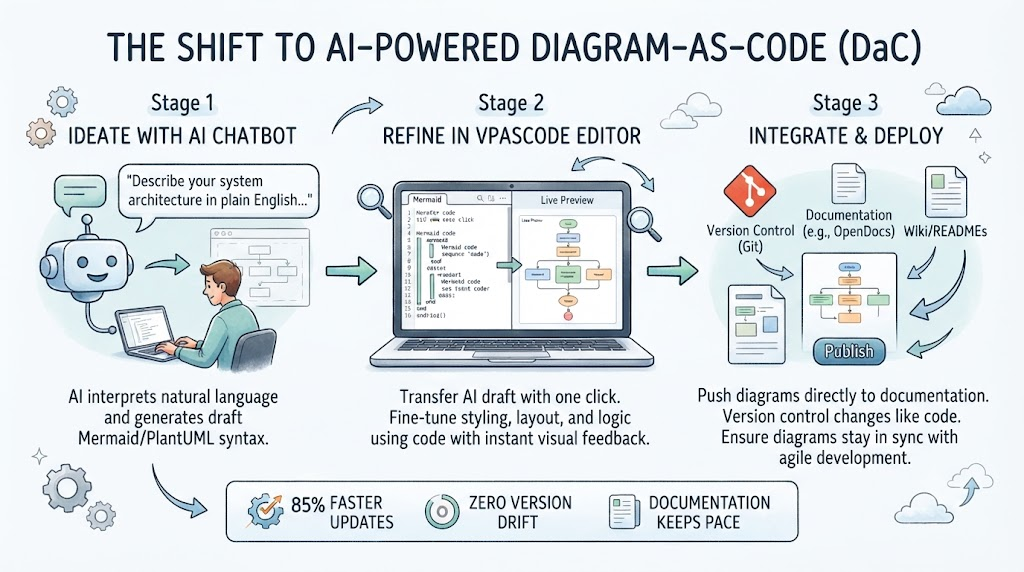
Today, a more efficient paradigm known as Diagram-as-Code (DaC) is emerging. By combining the creativity of natural language with the precision of code syntax, and supercharging this workflow with AI, architects can now generate professional diagrams in seconds. This tutorial explores the three-stage ecosystem of AI ideation, code refinement, and agile integration.
Stage 1: Ideation with the AI Chatbot
The journey begins where human creativity lives: natural language. Instead of navigating complex toolbars or memorizing syntax, the architect acts as a “director,” describing the system’s intent to an AI assistant.
This stage solves the “blank page” problem. You don’t need to know the exact syntax for a Mermaid or PlantUML diagram. You simply describe the relationships.
Example Prompt:
“Create a microservice architecture for a food delivery app with customers, delivery drivers, and restaurant managers. Show how they interact with the main application.”
The AI interprets this intent and generates the underlying diagram structure. It handles the heavy lifting of determining which nodes are needed and how they should logically connect. The output is a complete, syntactically correct draft ready for refinement.
Stage 2: Refinement in the VPasCode Editor
While AI is excellent at generating a “first draft,” software architecture requires precision. This is where the VPasCode ecosystem bridges the gap between the AI’s 90% solution and the final 10% of perfection.
The workflow is seamless: with a single click, the AI-generated draft is transferred from the chat interface to the VPasCode editor. This reveals the underlying code, allowing you to exercise granular control.
The “Last Mile” Problem of AI Generation
AI models are probabilistic; they predict the next likely token. While this is great for structure, it can sometimes miss specific styling nuances or strict logical requirements. VPasCode solves this by providing:
- Granular Control: Modify styling, layout, and logic directly through code.
- Multi-Engine Support: Seamlessly switch between Mermaid, PlantUML, and Graphviz depending on the complexity of the diagram.
- Real-time Preview: See changes instantly as you edit the code.
Here is an example of how a Mermaid sequence diagram looks when you refine the AI’s output to ensure proper alignment and specific interaction flows:
sequenceDiagram
    autonumber
    participant C as Customer
    participant App as Food App
    participant DB as Database
    participant R as Restaurant

    C->>App: Order Food
    App->>DB: Save Order
    DB-->>App: Order Confirmed
    App->>R: Notify Kitchen
    R->>App: Food Ready
    App->>C: Delivery Status
Stage 3: Integrate & Deploy
The final stage transforms the diagram from a static image into a living component of your software infrastructure. In traditional workflows, diagrams are exported as PNGs or PDFs, breaking the link between the code and the documentation.
In the Diagram-as-Code workflow, the diagram is the code. This allows for:
- Version Control (Git): Push diagrams directly to repositories like Git. Track changes, review diffs, and revert errors just like you would with application code.
- Documentation Sync: Embed diagrams directly into Wikis, OpenDocs, or READMEs. Because the source is code, the documentation stays in sync with the architecture.
- Agile Alignment: Update the diagram code alongside the feature branch. The diagram evolves with the sprint, ensuring zero version drift.
Why This Matters for Modern Teams
The shift to AI-powered Diagram-as-Code is not just about saving time; it is about improving the fidelity of your documentation. By treating diagrams as code, teams eliminate the friction of “updating the diagram.” The cost of documentation drops significantly, and the value of the diagram increases because it remains accurate.
Whether you are designing a simple sequence diagram or a complex microservice architecture, the combination of AI ideation and VPasCode refinement offers a professional, scalable, and future-proof approach to system modeling.
 vpadmin
- October 16, 2026
