


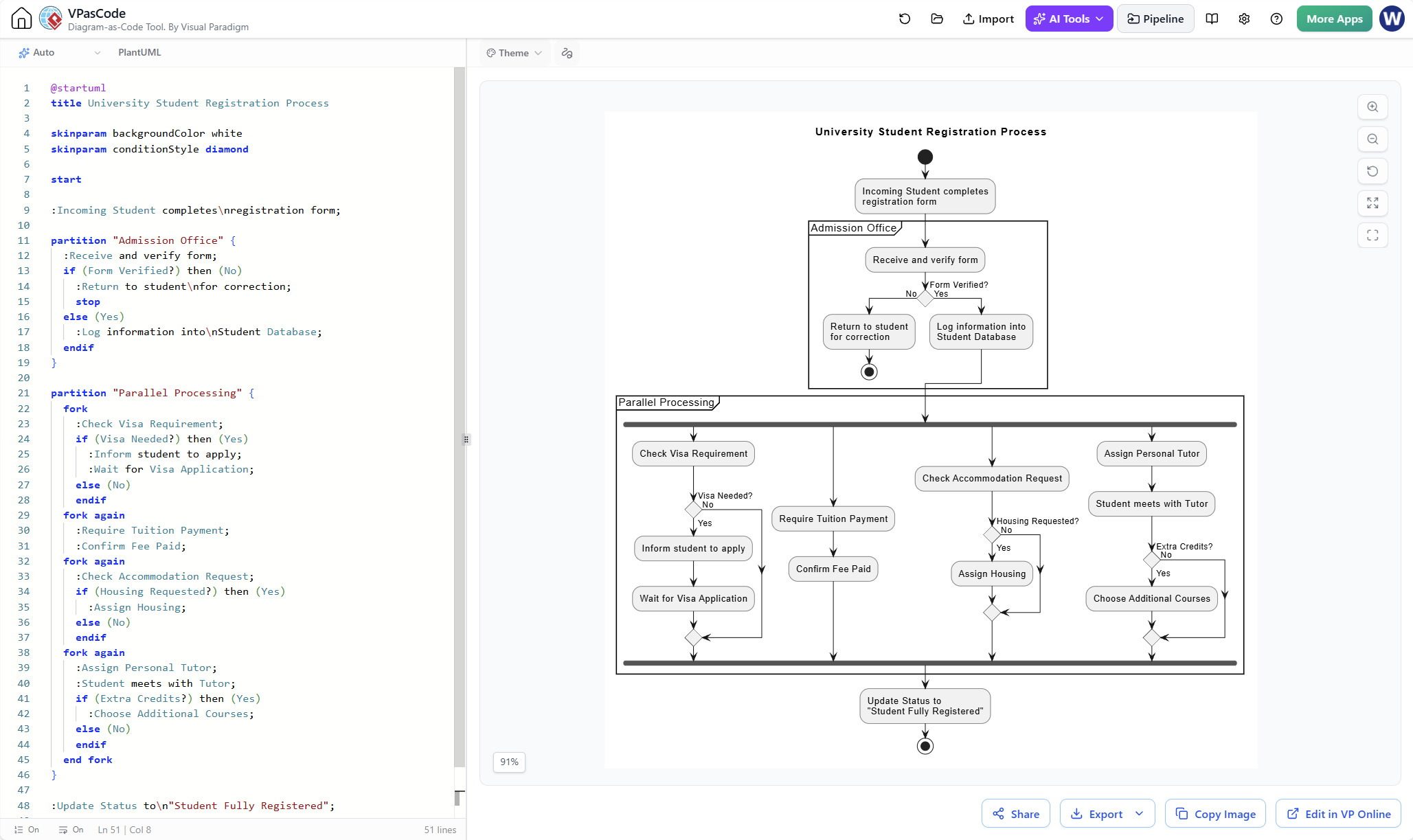
In modern systems analysis and software architecture, few challenges are as complex as modeling workflows that involve both strict sequential dependencies and simultaneous parallel activities. The University Student Registration Process presented here serves as a quintessential example of a “Level 1” context diagram, utilizing PlantUML to orchestrate a sophisticated flow of events. By leveraging the VPasCode tool within Visual Paradigm, we can translate complex logic into a visual representation that is both human-readable and machine-verifiable.
This tutorial dissects the underlying architecture of this registration system, exploring how Partitions organize business domains and how Fork/Join structures manage concurrent processing requirements.
Architectural Overview: From Monolith to Parallelism
The system is divided into distinct phases. Initially, the process is linear and centralized within the Admission Office. However, once the form is verified, the architecture shifts to a parallel execution model. This is a critical design pattern in business process management (BPM) where independent tasks—such as visa processing, tuition payment, and housing assignment—can occur simultaneously to reduce overall cycle time.
The diagram utilizes the fork construct to initiate these parallel threads. Unlike a simple waterfall model, this architecture allows the system to validate a student’s eligibility across multiple vectors at the same time.
Step-by-Step Logic Analysis
Phase 1: The Admission Gatekeeper
The process begins with the start node, where an incoming student completes the registration form. This triggers the partition "Admission Office", which acts as the initial gatekeeper.
- Verification Logic: The process checks if the
Form Verified?. If the answer is No, the flow detaches and returns to the student for correction. If Yes, the data is logged into the Student Database, acting as the trigger for the subsequent parallel phase.
Phase 2: The Parallel Processing Engine
Once the form is verified, the system enters the partition "Parallel Processing". This is where the diagram demonstrates advanced modeling capabilities using nested fork statements.
The architecture spawns four distinct threads of execution:
- Visa Requirement Check: This is a conditional branch. If a visa is needed, the student is informed, and the process waits for the application. If not, the thread detaches immediately.
- Tuition Payment: This is a straightforward sequential check requiring confirmation of fee payment.
- Housing Request: This thread checks for accommodation requests. If requested, housing is assigned; otherwise, the process skips this step.
- Tutor Assignment & Extra Credits: This thread assigns a personal tutor and checks for “Extra Credits,” allowing for dynamic course selection.
Technical Implementation: The VPasCode Syntax
Understanding the code behind the visual is essential for replication. The PlantUML code below illustrates the precise syntax used to achieve the “Fork and Join” pattern. The key to this architecture is the fork keyword, which splits the flow, and the implicit join that occurs when the end fork directive is reached.
@startuml
title University Student Registration Process
skinparam backgroundColor white
skinparam sequenceLifeLineBackgroundColor #FFE0E0

start
:Incoming Student completes
registration form;

partition "Admission Office" {
    :Receive and verify form;
    if (Form Verified?) then (No)
        :Return to student
for correction;
        detach
    else (Yes)
        :Log information into
Student Database;
    endif
}

partition "Parallel Processing" {
    fork
        :Check Visa Requirement;
        if (Visa Needed?) then (Yes)
            :Inform student to apply;
            :Wait for Visa Application;
        else (No)
            detach
        endif
    fork again
        :Require Tuition Payment;
        :Confirm Fee Paid;
    fork again
        :Check Accommodation Request;
        if (Housing Requested?) then (Yes)
            :Assign Housing;
        else (No)
            detach
        endif
    fork again
        :Assign Personal Tutor;
        :Student meets with Tutor;
        if (Extra Credits?) then (Yes)
            :Choose Additional Courses;
        else (No)
            detach
        endif
    end fork
}

:Update Status to
"Student Fully Registered";
stop
@enduml
Notice how fork again is used to chain multiple parallel threads without needing to explicitly define separate fork blocks. This keeps the code concise and the logical structure flat.
Conclusion
This diagram exemplifies how modern tools like VPasCode can handle complex control flow logic. By combining conditional branching (if/else), partitioning (swimlanes), and parallel execution (forks), we create a robust model of the University’s registration ecosystem. This architecture ensures that the university system remains responsive and efficient, processing independent requirements without unnecessary bottlenecks.
 vpadmin
- November 9, 2026
