


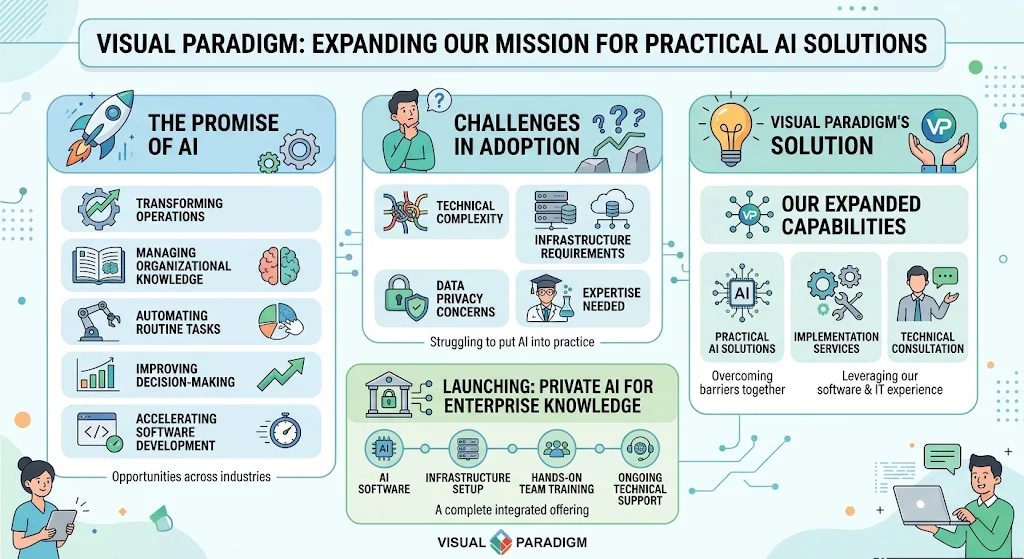
In the rapidly evolving landscape of enterprise technology, the gap between AI potential and practical application is often bridged by technical complexity. Visual Paradigm’s recent expansion into “Private AI for Enterprise Knowledge” represents a strategic shift from providing mere software tools to delivering comprehensive, integrated solutions. This tutorial explores the system architecture and modeling concepts required to design, implement, and manage such a solution, ensuring that organizations can leverage AI without the burden of building the underlying infrastructure from scratch.
1. The Architecture of Private Enterprise AI
Before diving into modeling, it is essential to understand the four pillars of the “Private AI” solution. Unlike public cloud AI models that require sending sensitive data to external servers, a Private AI solution keeps data and processing within the organization’s secure environment. The architecture relies on the integration of four distinct components:
- AI Software: The core intelligence layer, typically involving Large Language Models (LLMs) or Machine Learning engines capable of understanding natural language and generating insights.
- Infrastructure Setup: The hardware and cloud environment (on-premise or private cloud) required to host the AI models securely.
- Hands-on Team Training: The human element, ensuring staff can utilize the tools effectively.
- Ongoing Technical Support: Maintenance and optimization of the system over time.
To model this complex ecosystem, we use a combination of Logical View diagrams and Data Flow diagrams. Below is a PlantUML representation of the logical architecture, illustrating how these components interact to create a secure knowledge loop.
@startuml
title Private Enterprise AI Architecture: Logical View

package "Secure Enterprise Environment" {
    actor "Employee/User" as User
    entity "Knowledge Base (RAG)" as KB
    component "AI Engine / LLM" as AI
    component "Security & Access Control" as Sec
}

package "External Support" {
    component "Technical Support Team" as Support
    component "Training Resources" as Train
}

User --> Sec : 1. Authenticate & Query
Sec --> AI : 2. Pass Context (Sanitized)
AI --> KB : 3. Retrieve Relevant Data
KB --> AI : 4. Return Context
AI --> Sec : 5. Generate Response
Sec --> User : 6. Display Result

Support --> AI : 7. Model Updates & Maintenance
Train --> User : 8. Skill Development
@enduml
2. Modeling the “Challenge-to-Solution” Flow
The infographic provided highlights a critical narrative: moving from “Challenges in Adoption” to “Our Expanded Capabilities.” In Visual Paradigm, we can model this transition using a State Transition Diagram or a Business Process Model. This helps stakeholders visualize the journey from a state of “Struggling with Technical Complexity” to “Operational Efficiency.”
Let’s construct a Mermaid diagram to map out the decision logic an enterprise faces when adopting this solution. This diagram helps in analyzing the barriers (Technical Complexity, Data Privacy) and mapping them to the solution components (Implementation Services, Infrastructure Setup).
graph TD
    Start[Enterprise Starting Point] --> Challenges{Adoption Barriers?}

    Challenges -- Yes --> Comp1[Technical Complexity]
    Challenges -- Yes --> Comp2[Infrastructure Req]
    Challenges -- Yes --> Comp3[Data Privacy]
    Challenges -- Yes --> Comp4[Expertise Needed]

    Comp1 --> Solution[Private AI Solution]
    Comp2 --> Solution
    Comp3 --> Solution
    Comp4 --> Solution

    Solution --> Action1[Infrastructure Setup]
    Solution --> Action2[AI Software Deployment]
    Solution --> Action3[Team Training]

    Action1 --> Benefit[Private Knowledge Management]
    Action2 --> Benefit
    Action3 --> Benefit

    Benefit --> End[Operational Success]

    style Solution fill:#e1f5fe,stroke:#01579b,stroke-width:2px
    style Benefit fill:#f1f8e9,stroke:#33691e,stroke-width:2px
3. The Concept of “Quick AI Visual Modeling”
The supplementary note mentions “Integrated Quick AI Visual Modeling.” This concept refers to using AI to assist in the creation of the very diagrams that define the system. In a Visual Paradigm ecosystem, this means using an AI assistant to generate UML diagrams from natural language prompts. For example, a project manager could type: “Create a use case diagram for a Private AI system where users query a knowledge base.” The AI would then generate the actors, use cases, and relationships automatically.
This accelerates the “Infrastructure Setup” and “Modeling” phases of the project, reducing the time from conception to deployment.
4. Implementation Strategy: The Data Flow
For an enterprise to truly benefit from Private AI, the data flow must be secure and efficient. The “Private AI for Enterprise Knowledge” solution implies a Retrieval-Augmented Generation (RAG) architecture. Here is a step-by-step breakdown of the data flow:
- Ingestion: Organizational documents (PDFs, Wikis, Emails) are ingested into the Knowledge Base.
- Embedding: The AI software converts this text into vector embeddings (mathematical representations of meaning).
- Querying: A user asks a question in natural language.
- Retrieval: The system searches the Knowledge Base for relevant context.
- Generation: The AI generates a response based on the retrieved context, ensuring the answer is grounded in company data, not just general internet knowledge.
@startuml
title Private AI Knowledge Flow

participant "User Query" as User
participant "AI Interface" as Interface
participant "Vector DB" as VectorDB
participant "LLM" as LLM
participant "Knowledge Base" as KB

User -> Interface : Ask Question
Interface -> LLM : Convert Query to Vector
LLM -> VectorDB : Search Similarity
VectorDB --> LLM : Return Top Matches
LLM -> KB : Retrieve Text Context
KB --> LLM : Return Context
LLM --> Interface : Generate Answer
Interface --> User : Display Answer
@enduml5. Conclusion: Bridging the Gap
The transition from “Software Products” to “AI Solutions” is not just about adding a new feature; it is about providing a holistic ecosystem. By addressing the technical barriers of infrastructure and expertise, and providing a secure environment for organizational knowledge, Visual Paradigm enables businesses to focus on what matters: the value AI brings to their operations. Through rigorous modeling and integrated solutions, the path to AI adoption becomes clear, manageable, and practical.
 vpadmin
- November 12, 2026
