


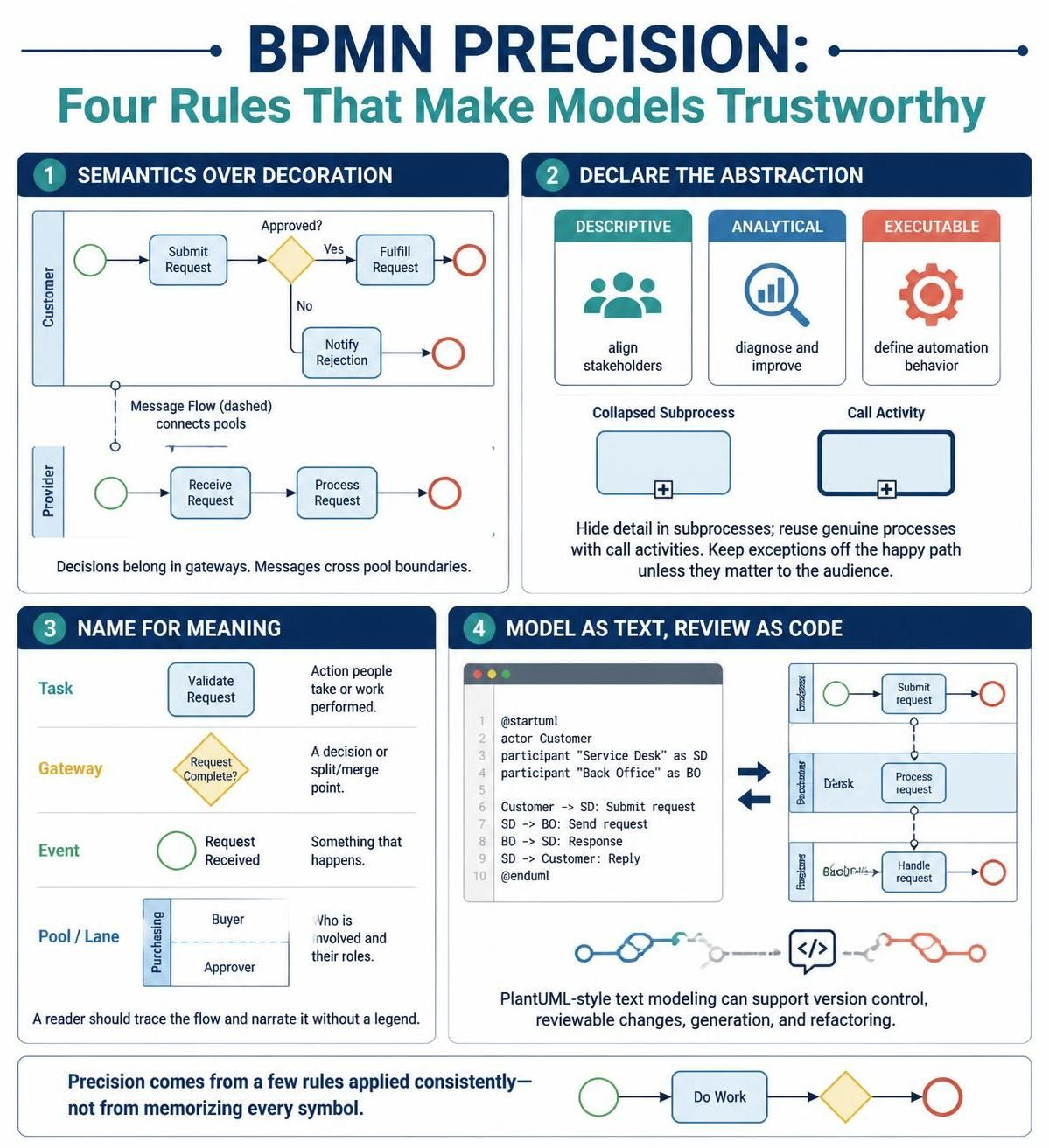
In the world of Business Process Management, precision is the currency of trust. BPMN (Business Process Model and Notation) rewards accuracy, but this precision comes at a price: the notation offers well over a hundred symbols. It is this vast complexity that makes the notation powerful, yet it is also the primary reason why most BPMN diagrams found in the wild are unreliable. The escape from this trap is not memorizing every icon, but rather internalizing a small number of critical rules and applying them relentlessly.
This tutorial explores the architecture of trustworthy BPMN modeling, focusing on four foundational pillars: semantics over decoration, declared abstraction, meaningful naming, and text-based modeling. By adhering to these principles, you transform your diagrams from static drawings into reliable blueprints that both business stakeholders and IT developers can genuinely share.
1. Semantics Over Decoration
The first rule of precision is to prioritize the meaning of elements over their visual decoration. Many modelers fall into the trap of using tasks to represent decisions or using sequence flows to represent communication across organizational boundaries. To build a trustworthy model, you must strictly adhere to the semantic definitions of the notation.
- Decisions Belong in Gateways: A gateway exists to split or merge control flow. Therefore, a decision belongs in a gateway, never in a task named “Decide whether to approve.” If a task is named “Approve,” it implies an action. If the logic requires a Yes/No branch, that logic belongs in a diamond-shaped gateway.
- Message Flows Cross Boundaries: A message between participants (pools) is strictly a message flow (dashed line), never a sequence flow. Sequence flows represent the flow of control within a process. Crossing a pool boundary with a sequence flow is a cardinal sin in BPMN.
- Completeness: A start event, an end event, and a balanced pair of splits and joins should all be present in anything you intend to execute or audit. An incomplete model cannot be trusted.
2. Declare the Abstraction
The second rule is that abstraction must be declared, not implied. A single canvas often tries to serve three conflicting purposes: alignment (Descriptive), diagnosis (Analytical), and automation (Executable). Mixing these three produces a diagram that is unreadable. You must choose your level of detail.
Modeling Purposes
- Descriptive Models: Serve to align stakeholders. These are high-level and simplified.
- Analytical Models: Serve to diagnose and improve. These require specific details about bottlenecks or data.
- Executable Models: Serve automation. These must be precise enough for a BPM engine to run.
Techniques for Abstraction
When you need to hide complexity, do not flatten it. Instead, use specific mechanisms to declare that detail exists elsewhere:
- Collapse Detail into a Subprocess: Use a collapsed subprocess to hide a complex workflow that is not relevant to the current view.
- Use Call Activities: Use a call activity when a process is genuinely reused across multiple diagrams. This ensures that the logic is defined once and referenced everywhere.
- Resist the “Happy Path” Trap: Do not draw every exception on the main diagram unless they matter to the specific audience. Keep the “happy path” clean.
3. Name for Meaning
The third rule is that naming carries the meaning. A diagram should be self-explanatory. If a reader has to consult a legend to understand a symbol, the model has failed. A reader should be able to trace a token from start to end and narrate the process out loud without consulting a legend.
Best Practices for Naming
- Verb-Noun Tasks: Tasks should be named with a verb and a noun (e.g., “Validate Request”) to clearly indicate an action.
- Question-Form Gateways: Gateways represent decisions. They should be named with a question (e.g., “Request Complete?”) to clarify the logic being evaluated.
- State-Change Events: Events should represent something that happens, often a state change (e.g., “Request Received”).
- Consistent Pool/Lane Names: Pool and lane names must consistently define “Who is involved and their roles.”
4. Model as Text, Review as Code
Finally, notation is a means, and text is a means of producing it. Writing BPMN models using text-based tools (like PlantUML or VPasCode) keeps the model in version control. This allows differences to be reviewed like code, and diagrams to be generated and refactored rather than redrawn. This approach ensures that diagrams stay accurate as the process changes.
Benefits of Text-Based Modeling
By treating your process model as text, you gain the ability to use standard software engineering practices. You can compare versions, automate generation, and refactor complex logic without the visual clutter of dragging and dropping shapes. This discipline transforms BPMN from a drawing exercise into a robust system architecture tool.
Conclusion
Used with discipline, BPMN stops being a drawing exercise and becomes what its name promises: a notation that business and IT can genuinely share. The patterns discussed here—external participants, internal handoffs, conditional routing, event-driven waits, and exception paths—scale from small examples to enterprise-scale models. Build these patterns correctly at the small scale, and the enterprise-scale models will follow.
 vpadmin
- November 10, 2026
