


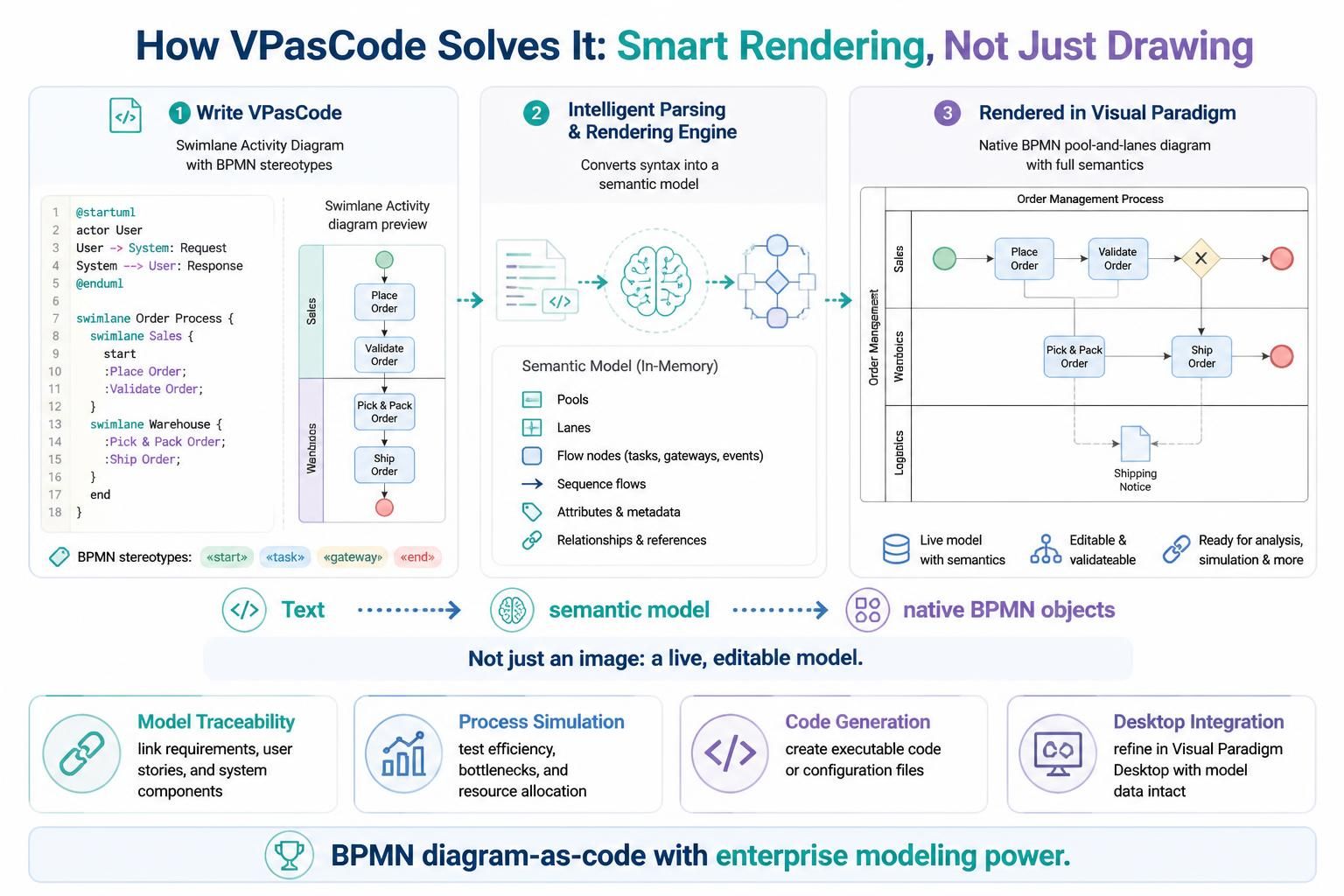
In the world of software engineering and business process management, the gap between design and implementation is often bridged by manual diagramming tools. However, VPasCode represents a paradigm shift. It transforms the way we create Business Process Model and Notation (BPMN) diagrams by treating text as the source of truth for complex semantic models.
This tutorial explores the architecture of VPasCode, specifically focusing on how it converts a simple text definition into a “live, intelligent model” within the Visual Paradigm ecosystem. We will walk through the “Smart Rendering” process, analyze the underlying syntax, and demonstrate the unique enterprise capabilities that result from this approach.
1. The Core Philosophy: Text as a Semantic Model
Traditional diagramming tools often treat a diagram as a collection of shapes and lines on a canvas. When you export these as images or static PDFs, you lose the data. VPasCode flips this logic. When you write code in VPasCode, you are not creating a generic picture; you are defining a semantic model.
The workflow follows a rigorous transformation path:
- Input: Human-readable text using a specific syntax.
- Processing: An intelligent parsing engine interprets the syntax.
- Output: Native Visual Paradigm BPMN objects (Pools, Lanes, Tasks, Gateways).
Because the output is native BPMN objects rather than a static image, the resulting diagram is fully editable, analyzable, and ready for simulation.
2. Understanding the Syntax: Swimlanes and Stereotypes
The power of VPasCode lies in its ability to use a “Swimlane Activity Diagram” syntax enhanced with BPMN stereotypes. This allows developers to define the structure of a process (who does what) and the logic (how the process flows) simultaneously.
Let’s break down the syntax used in the Order Management Process example:
@startuml
actor User
actor System: Request
User -> System: Request
System --> User: Response
@enduml

swimlane Order Process {
  swimlane Sales {
    start
    :Place Order;
    :Validate Order;
  }
  swimlane Warehouse {
    :Pick & Pack Order;
    :Ship Order;
  }
  end
}
Key Syntax Components:
-
@startuml / @enduml:
These define the scope of the diagram block. - Actor Definitions: We define entities like
UserorSystem. Note how theSystemactor is given a specific stereotype (: Request) to denote its role in the interaction. - Navigational Flow: The
User -> Systemsyntax represents the sequence flow or message flow between actors. - Swimlane Structure: The
swimlane { ... }block is crucial. It hierarchically organizes the process.swimlane Order Processacts as the main container (Pool).swimlane Salesandswimlane Warehouseact as sub-pools or Lanes, assigning tasks to specific departments.
- Task Definition: Tasks are defined using the format
:Task Name;. For example,:Pick & Pack Order;is automatically converted into a BPMN Task element.
3. The Intelligent Parsing & Rendering Engine
Once the text is written, the VPasCode engine takes over. This is the “Smart Rendering” phase mentioned in the architectural overview. The engine performs the following logical steps:
- Syntax Interpretation: It reads the code line-by-line, identifying keywords like
swimlane,start, andend. - Model Construction: It constructs an in-memory semantic model. This is not a visual representation yet; it is a data structure containing:
- Pools & Lanes: The organizational structure.
- Flow Nodes: The tasks, gateways, and events.
- Sequence Flows: The connections between nodes.
- Attributes & Metadata: Hidden data that allows for traceability.
- BPMN Rendering: Finally, it renders this semantic model into the Visual Paradigm native format.
The result is a diagram that looks like a professionally drawn BPMN chart but is actually a fully functional object tree. For instance, the decision logic in the diagram (the diamond shape) is not just a yellow diamond; it is a BPMN Gateway object with defined outgoing paths.
4. The Unique Advantage: Enterprise Traceability
The most significant benefit of using VPasCode is that it generates real BPMN objects. This unlocks capabilities that “diagram-as-image” tools simply cannot offer.
Model Traceability
Because the diagram is a native model, you can link BPMN elements directly to external requirements, user stories, or system components. If you write a user story in your project management tool, you can link it to the :Validate Order; task in your VPasCode diagram.
Process Simulation
The semantic model contains the data needed for simulation. You can run simulations to test process efficiency, identify bottlenecks, and analyze resource allocation directly from the generated model. For example, you can simulate the Warehouse swimlane to see how long it takes to Pick & Pack Order under different load conditions.
Code Generation
This is the “Holy Grail” of automation. Since the diagram is a formal model, you can generate executable code or configuration files from it. This allows for “Model-Driven Development” (MDD), where the process diagram drives the actual application logic.
Desktop Integration
VPasCode seamlessly integrates with Visual Paradigm Desktop. You can generate a diagram from text and then send it to the desktop application for advanced refinement. Crucially, because it is a native model, no data is lost during this transfer. All attributes, links, and metadata remain intact.
Conclusion
VPasCode bridges the gap between developer syntax and business modeling standards. By utilizing a sophisticated engine that interprets text as a semantic model, it empowers users to create diagrams that are not just static images, but living, intelligent models ready for simulation, analysis, and code generation. This makes it the premier choice for BPMN diagram-as-code with true enterprise modeling power.
 vpadmin
- October 15, 2026
