


In modern software engineering, bridging the gap between abstract design and concrete implementation is crucial. Visual Paradigm VPasCode offers a revolutionary approach to this challenge by allowing developers to define complex Class Diagrams using simple, text-based syntax. This tutorial explores how to model a Hotel Management System, focusing on the core Object-Oriented (OO) concepts of Interfaces, Abstract Classes, and Class Relationships.
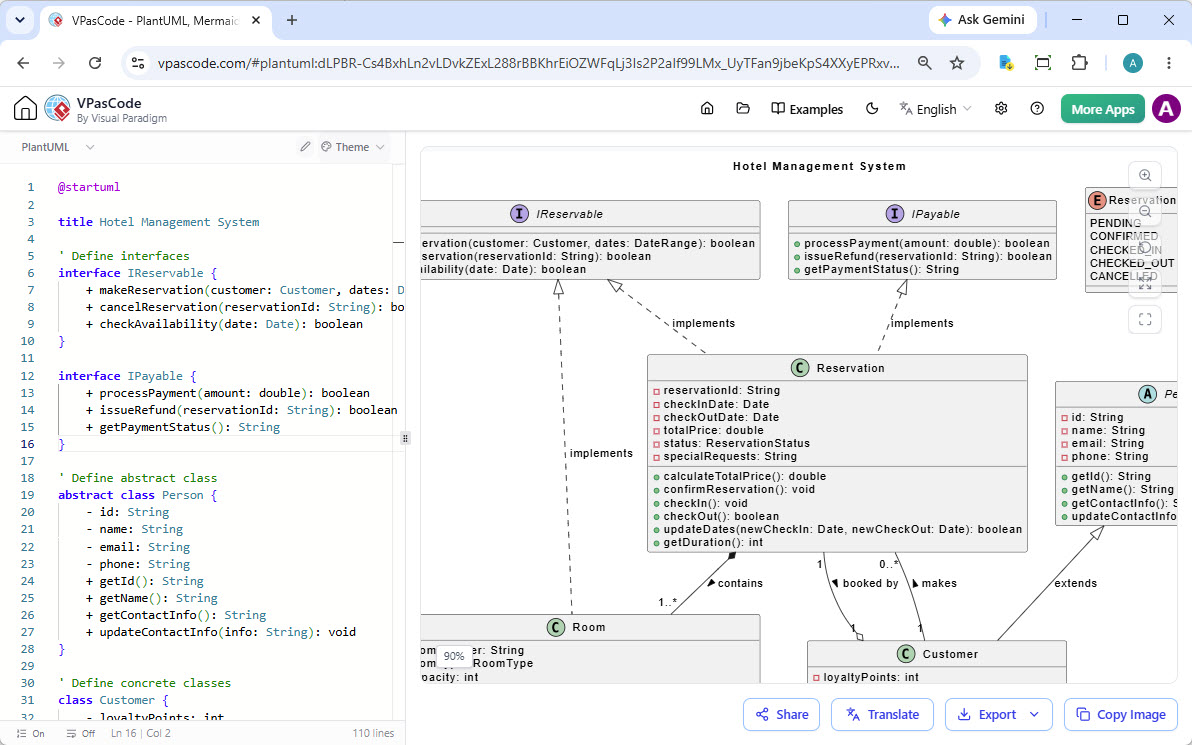
The screenshot provided demonstrates a robust Class Diagram that models the business logic of a hotel booking system. By using VPasCode, we can leverage the power of PlantUML to render these relationships dynamically.
1. The Power of Interfaces
In Object-Oriented Programming, an Interface defines a contract. It specifies what a class can do, but not how it does it. In the provided diagram, we see two critical interfaces: IReservable and IPayable.
These interfaces enforce specific behaviors across different entities. For instance, IReservable ensures that any object implementing it must be able to handle reservations, cancellations, and availability checks. This allows for polymorphism, where different classes (like a Room or a Service) can be treated uniformly if they implement the same interface.
Here is how the interface definitions are structured in VPasCode:
' Define interfaces
interface IReservable {
    + makeReservation(customer: Customer, dates: DateRange): boolean
    + cancelReservation(reservationId: String): boolean
    + checkAvailability(date: Date): boolean
}

interface IPayable {
    + processPayment(amount: double): boolean
    + issueRefund(reservationId: String): boolean
    + getPaymentStatus(): String
}
2. Abstract Classes and Inheritance
While interfaces define capabilities, Abstract Classes provide a blueprint for common implementation details. In our diagram, the Person class is defined as abstract.
This design pattern is excellent for modeling the Hotel Management System because not every entity in the system is a “Person”—some are “Rooms” or “Reservations.” However, People (like Customers and Employees) share common attributes such as id, name, and email. By making Person abstract, we ensure these fields are defined once and inherited by concrete subclasses, reducing code duplication.
' Define abstract class
abstract class Person {
    - id: String
    - name: String
    - email: String
    - phone: String
    + getId(): String
    + getName(): String
    + getContactInfo(): String
    + updateContactInfo(info: String): void
}
3. Concrete Classes and Relationships
The diagram also showcases how concrete classes like Room, Customer, and Reservation interact. VPasCode handles the visualization of these relationships beautifully:
- Realization (Dashed Line with Hollow Triangle): The diagram shows that
Reservationimplements bothIReservableandIPayable. This means a Reservation object has the authority to manage its own booking status and handle payments. - Composition (Solid Line with Filled Diamond): The relationship between
ReservationandRoomis marked as “contains.” The filled diamond indicates Composition, a strong form of aggregation where the child (Room) cannot exist independently of the parent (Reservation) in this specific context. - Inheritance (Solid Line with Hollow Triangle): The
Customerclass extendsPerson, inheriting all contact details while adding specific attributes likeloyaltyPoints.
4. The VPasCode Workflow
The screenshot illustrates the split-pane editor of VPasCode. On the left, you write the semantic text description. On the right, the tool renders the graphical representation in real-time. This “Diagram as Code” approach offers several advantages:
- Version Control Friendly: Unlike binary image files, text-based diagrams can be easily tracked in Git.
- Quick Iteration: Changing a relationship or adding an attribute is as simple as editing a line of text and hitting save.
- Standard Compliance: The syntax strictly adheres to UML standards, ensuring that the resulting diagrams are readable by other engineers.
By mastering these concepts, you can rapidly prototype complex system architectures, ensuring your team is aligned on the design before writing a single line of production code.
 vpadmin
- October 14, 2026
