


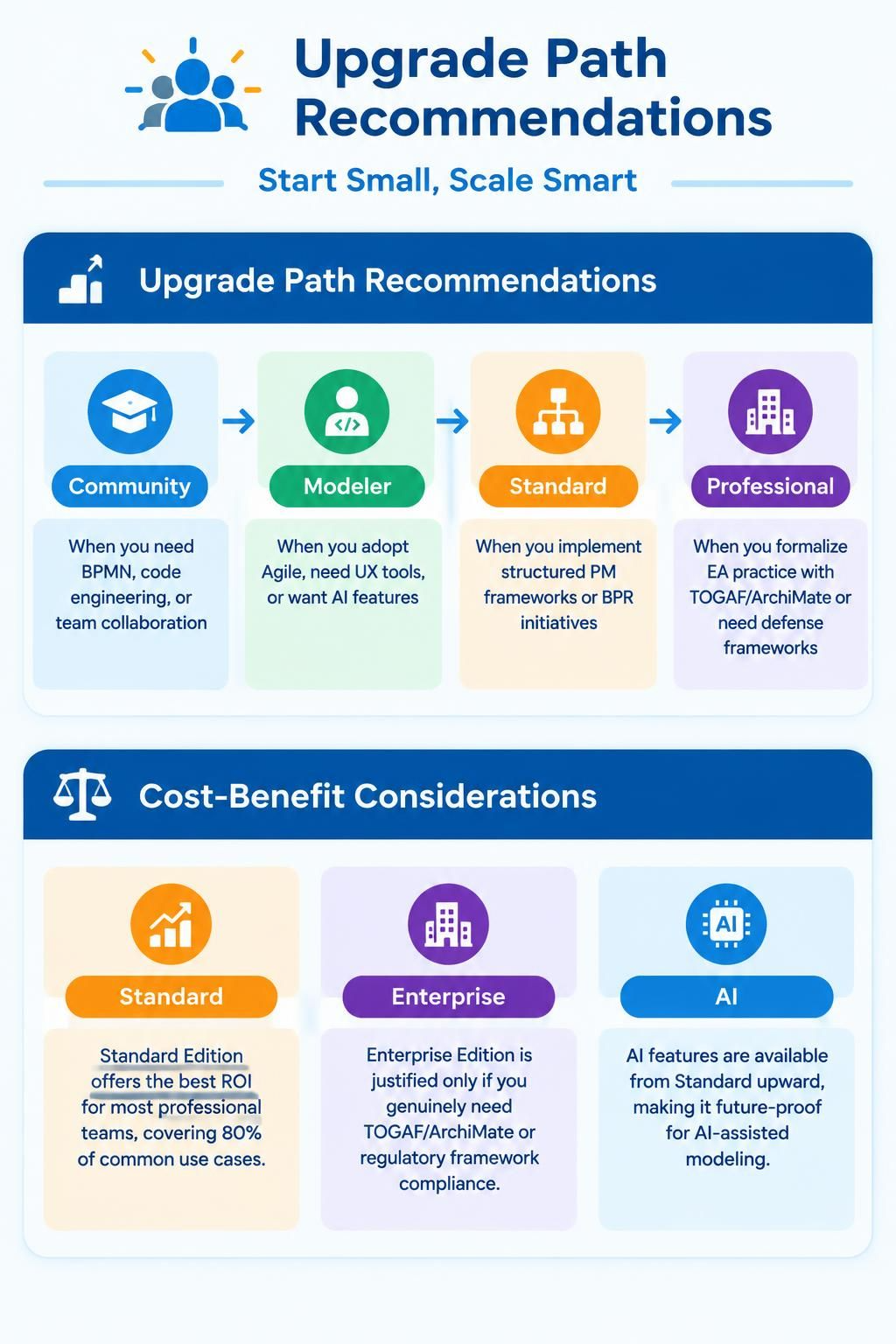
Choosing the right edition of a modeling tool is not merely a purchasing decision; it is a strategic choice that dictates the maturity of your software development lifecycle (SDLC) and your ability to scale complex systems. Visual Paradigm offers a tiered architecture that aligns with organizational growth, moving from individual hobbyists to large-scale enterprise governance.
This tutorial explores the logical progression of Visual Paradigm Desktop Editions. We will analyze the transition from the Community and Modeler versions to the professional Standard and Enterprise levels, understanding exactly why and when to upgrade.
The Strategic Upgrade Ladder
The upgrade path is designed to follow the evolution of a team’s needs. It begins with the ability to model and progresses toward comprehensive governance and regulatory compliance.
1. The Foundation: Community to Modeler
The journey typically starts with the Community edition, which is excellent for learning and individual practice. However, as soon as you require specific industry-standard methodologies or team collaboration, the Modeler edition becomes the logical next step.
- Community Edition: Best for learning the basics.
- Modeler Edition: This is the critical pivot point. You should upgrade here when your requirements expand beyond simple diagrams to include BPMN (Business Process Model and Notation) for process mapping, Code Engineering for round-trip engineering with source code, or when you need Team Collaboration features to share models across a group.
2. The Professional Transition: Standard to Professional
Once a team is comfortable with the Modeler edition, they often outgrow its limitations regarding project management and process improvement.
- Standard Edition: This is the “sweet spot” for most professional teams. You should move to Standard when you adopt Agile methodologies and require integrated UX tools, or when you begin to utilize AI features to accelerate design.
- Professional Edition: This tier is justified when you need to implement structured Project Management (PM) frameworks or undertake comprehensive Business Process Reengineering (BPR) initiatives that require advanced analytics and reporting.
3. The Enterprise Apex
The final tier, Enterprise, is reserved for organizations that need to formalize their architecture practice.
- Enterprise Edition: This is the necessary choice when you are formalizing Enterprise Architecture (EA) using industry standards like TOGAF (The Open Group Architecture Framework) or ArchiMate. It is also essential for teams in regulated industries requiring defense frameworks or strict regulatory compliance.
Cost-Benefit Analysis and ROI
Understanding the financial and technical justification for each upgrade is crucial for IT managers and architects. The decision matrix is generally driven by three factors: Capability Coverage, Framework Compliance, and Future-Proofing.
Maximizing ROI with Standard Edition
For the vast majority of software development and business analysis teams, the Standard Edition provides the optimal balance of cost and capability. It covers the vast majority of common use cases, including:
- Comprehensive UML and BPMN modeling.
- Agile and Scrum integration.
- Database design and SQL generation.
If your organization does not strictly require TOGAF/ArchiMate compliance or specific government defense frameworks, the Standard Edition is typically the most efficient financial choice.
The Necessity of Enterprise for Compliance
The Enterprise Edition is a specialized tool. It is justified only if you genuinely need to model against specific architectural frameworks. This includes:
- TOGAF: For holistic Enterprise Architecture.
- ArchiMate: For visualizing business, application, and technology layers.
- Regulatory Compliance: Defense, banking, or healthcare industries often mandate specific modeling standards that only the Enterprise edition can fully support.
AI and Future-Proofing
A critical factor in the modern upgrade path is the integration of Artificial Intelligence. Visual Paradigm has embedded AI capabilities to assist with model generation and analysis. It is important to note that AI features are available from the Standard edition upward. This makes the Standard edition a “future-proof” entry point, ensuring you are not left behind by AI-assisted modeling trends even if you do not yet need Enterprise-level governance.
Summary: The Decision Logic
To summarize the upgrade logic, visualize the decision flow as follows:
- Start Small: Begin with Community for learning or Modeler if you need immediate BPMN/Code/Team features.
- Scale Smart: Upgrade to Standard when you need Agile, UX, and AI capabilities.
- Structure: Move to Professional for deep Project Management and BPR frameworks.
- Formalize: Reach Enterprise only when you require TOGAF, ArchiMate, or defense compliance.
By following this “Start Small, Scale Smart” approach, organizations ensure they are investing in the specific tools they need right now, while maintaining a clear path for future growth.
 vpadmin
- November 19, 2026
