


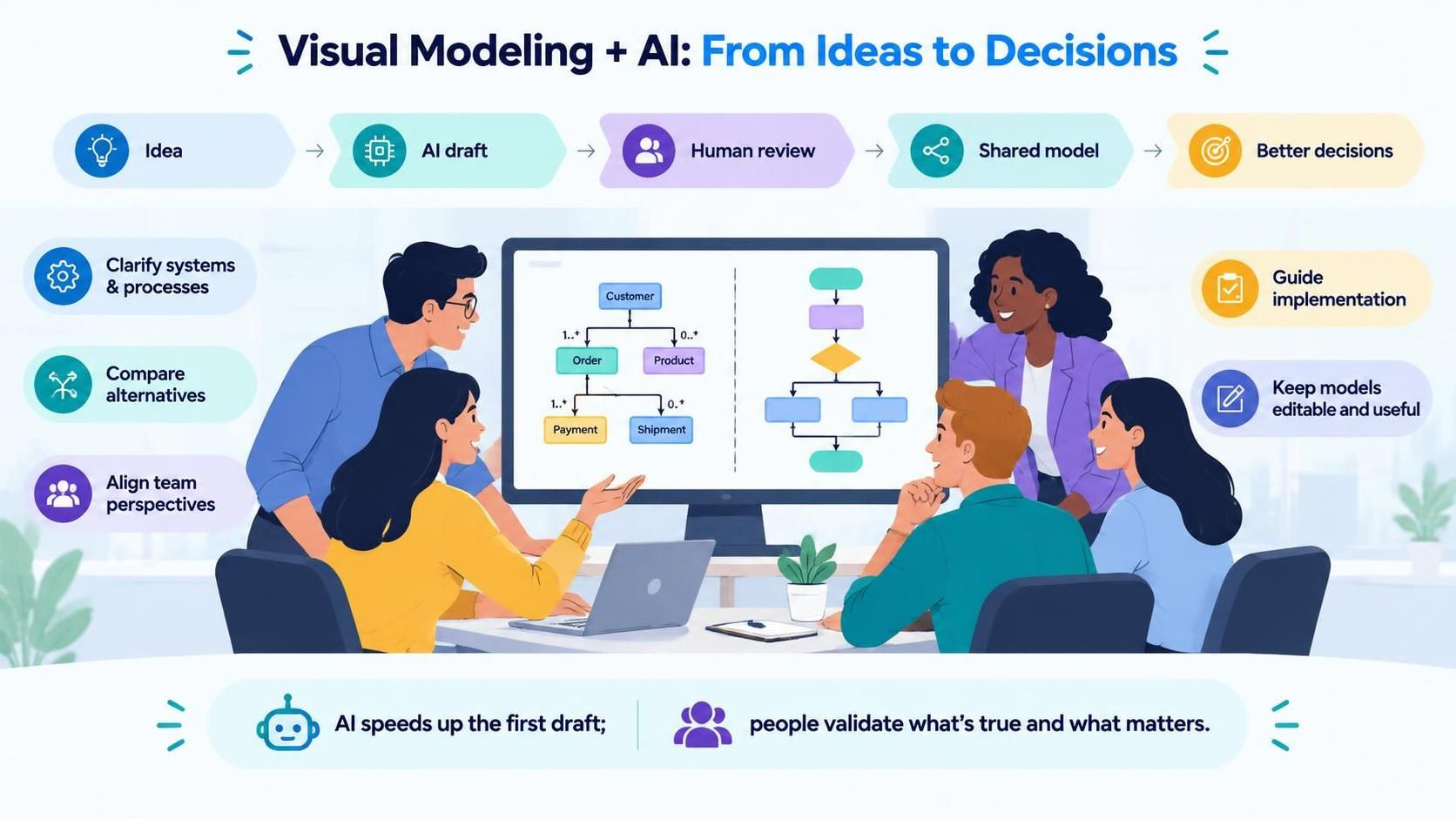
In modern software engineering and business analysis, the bridge between abstract ideas and concrete implementation is often built using visual modeling. However, the role of the modeler is evolving. As illustrated in the concept of “Visual Modeling + AI,” the process is no longer a solitary task of drawing boxes; it is a collaborative cycle involving AI assistance, human review, and strategic alignment.
This tutorial explores the architectural shift from static documentation to dynamic, AI-assisted modeling workflows, specifically focusing on how tools like Visual Paradigm enable teams to clarify systems, compare alternatives, and align perspectives.
The New Workflow: From Idea to Implementation
The traditional modeling lifecycle has been linear and often slow. The modern approach, powered by AI, accelerates the initial creation phase while maintaining rigorous human oversight. This creates a robust loop that ensures models are not just pictures, but actionable assets.
1. The AI Draft Phase
The journey begins with the “Idea.” In the past, capturing this idea required manual definition of every node and edge. Today, AI tools can generate a “First Draft” instantly. Whether it is an initial Class Diagram or a basic Data Flow Diagram, AI helps overcome the “blank page” syndrome by proposing structure based on natural language prompts.
2. Human Review & Validation
As noted in the context, “AI makes the first draft faster, but it does not remove the need for modeling.” The AI suggests what the system might look like, but the human team must decide what is true and what matters. This is the critical “Human Review” step where domain experts validate the logic, ensuring that the data relationships and process flows accurately reflect business reality.
3. Shared Model & Alignment
Once validated, the model becomes a “Shared Model.” In a collaborative environment, this single source of truth allows teams to discuss alternatives and keep related views aligned. For instance, if a developer changes a database schema in the Class Diagram, the data flow diagrams should ideally update to reflect that change, preventing the “decoupling” of documentation from code.
Core Modeling Concepts in the AI Era
To leverage these tools effectively, one must understand the specific modeling concepts that drive system architecture. The image highlights three primary benefits that stem from deep modeling engagement:
- Clarify Systems & Processes: Visualizing the “Customer,” “Order,” and “Shipment” entities (as seen in the diagram) helps teams understand the scope of the system before writing a single line of code.
- Compare Alternatives: Modeling allows teams to simulate different scenarios. “What if we remove the Payment step?” or “What if the Product category changes?” Visual Paradigm allows for rapid prototyping of these alternatives.
- Align Team Perspectives: Developers, stakeholders, and designers often speak different languages. A visual model acts as a universal translator, ensuring everyone agrees on the system’s behavior.
Technical Implementation: Visual Paradigm + No-Code Tooling
While the interface of Visual Paradigm is rich and feature-heavy, the underlying engine supports “No-Code” generation and integration. This means you can use high-level languages to define your model, which the tool then renders into professional diagrams.
Integrating Text-to-Diagram Logic
Visual Paradigm supports features that allow for model generation via text-based definitions. This is particularly useful for teams familiar with Python, PlantUML, Mermaid, or GraphViz syntax.
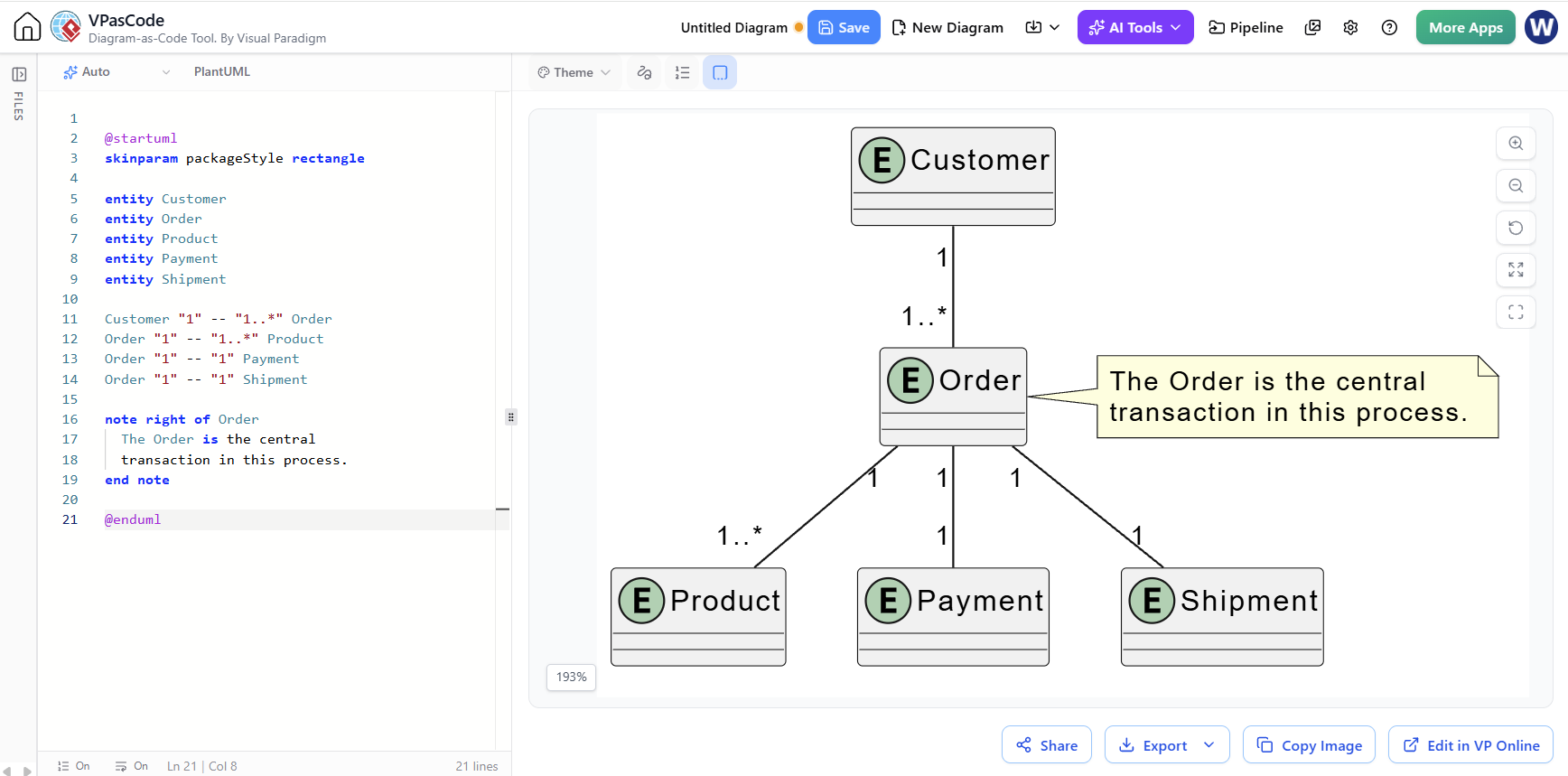
Consider a scenario where you want to define a simple order processing system. Instead of manually dragging boxes, you might use a text-based definition that looks like this:
@startuml
skinparam packageStyle rectangle

entity Customer
entity Order
entity Product
entity Payment
entity Shipment

Customer "1" -- "1..*" Order
Order "1" -- "1..*" Product
Order "1" -- "1" Payment
Order "1" -- "1" Shipment

note right of Order
  The Order is the central
  transaction in this process.
end note

@endumlWhen imported into Visual Paradigm, this code is parsed, and the relationships (1-to-Many, 1-to-1) are automatically constructed into a UML Class Diagram. This approach ensures that the model remains editable and version-controllable, treating the diagram as code.
The Human-in-the-Loop Advantage
The image emphasizes that while “AI speeds up the first draft,” the ultimate value comes from “people validating what’s true and what matters.”
This distinction is crucial for architectural governance. AI can hallucinate relationships or suggest standard patterns that don’t fit specific business constraints. The “Human Review” phase is where the architect applies judgment to:
- Ensure data integrity constraints are met.
- Validate that the “Payment” and “Shipment” processes align with actual logistics.
- Refine the model to guide future implementation decisions.
By combining the speed of AI-assisted features with the precision of human review, Visual Paradigm provides a platform where models are not just static pictures, but living artifacts that guide implementation.
 vpadmin
- November 17, 2026
