


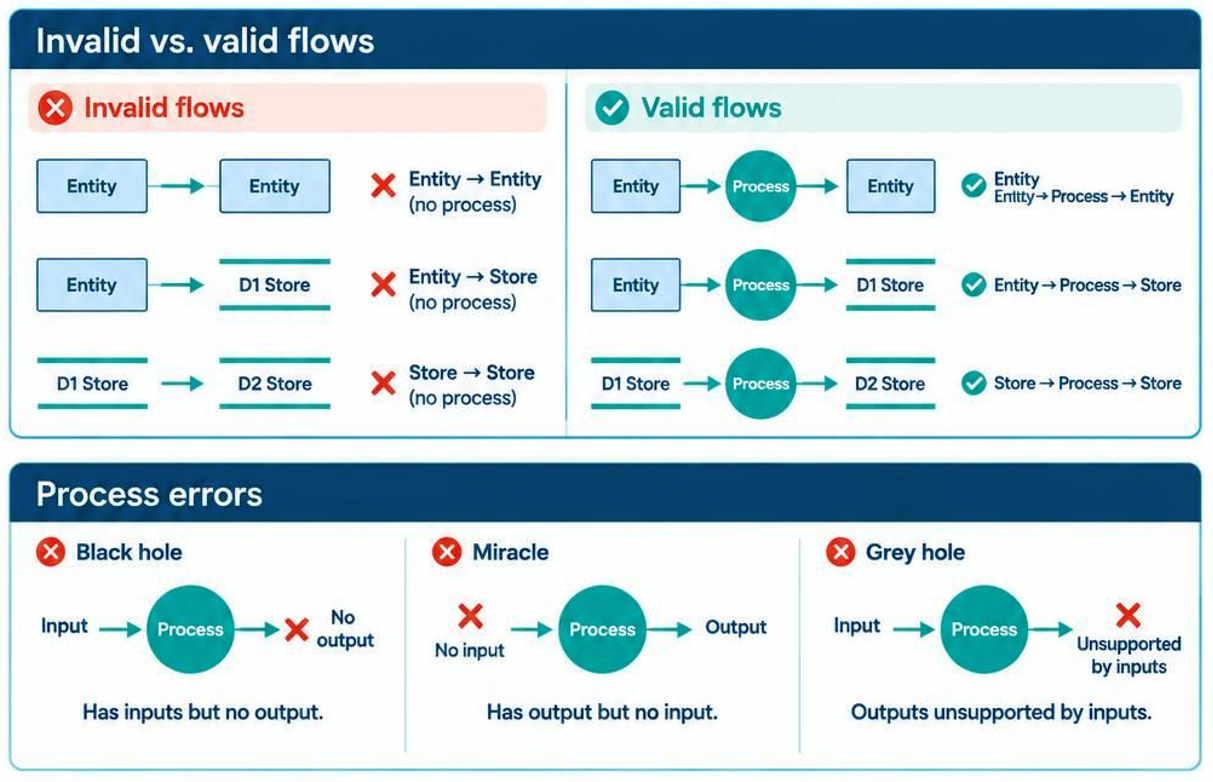
In the realm of system analysis and software architecture, clarity is paramount. A Data Flow Diagram (DFD) is not merely a drawing exercise; it is a rigorous logical contract between business requirements and system implementation. When using tools like Visual Paradigm’s DFD capabilities and VPasCode, you are essentially programming the logical behavior of your system. However, even the most experienced analysts can fall into the trap of creating “phantom” flows that violate the fundamental laws of data processing.
The Golden Rule: Transformation is Mandatory
The most common error in DFD modeling is the assumption that data can simply appear or disappear. In a valid system architecture, data is never static; it must always be acted upon. This is the principle of transformation. If data moves from point A to point B, something must happen to it in between.
Entity to Entity: The Direct Transfer Fallacy
Imagine a scenario where a Customer (Entity) sends an order directly to a Warehouse (Entity) without any system intervention. In a real-world software context, this is impossible. There must be a “Process” that validates the order, checks inventory, and confirms receipt.
- Invalid Flow: Entity → Entity (No Process)
- The Correction: You must insert a process node. The flow becomes Entity → Process → Entity.
- Why it matters: Without the process, the system has no logic to handle the request. It is a “magic” transfer that bypasses business rules.
Entity to Data Store: The Silent Write
Another frequent mistake is drawing a direct line from an external entity (like a User or Client) straight into a data store (like a Database). It looks like the user is writing directly to the database, but in a layered architecture, this is a security and architectural nightmare.
- Invalid Flow: Entity → Data Store (No Process)
- The Correction: Data must be processed. The flow must be Entity → Process → Data Store.
- Why it matters: The process acts as a gatekeeper, sanitizing inputs, validating data types, and applying business logic before any data is persisted.
Data Store to Data Store: The Silent Copy
Can data simply move from one database table to another without a trigger or a service? In a DFD, if you draw a direct line between D1 Store and D2 Store, you are implying that the data changes location without any logic being applied.
- Invalid Flow: D1 Store → D2 Store (No Process)
- The Correction: A process must mediate the transfer. D1 Store → Process → D2 Store.
- Why it matters: Data transformation, aggregation, or archiving almost always requires computational logic. If no logic is applied, the data flow is redundant.
Avoiding Process Errors: Black Holes, Miracles, and Grey Holes
Once you have established the correct flow paths, you must ensure the processes themselves are logically sound. Visual Paradigm and similar tools often flag these anomalies, but understanding them conceptually is crucial.
The Black Hole
A Black Hole is a process that has input flows but absolutely no output flows. It is a data sink.
- Definition: Data enters the process and vanishes.
- System Implication: This represents a broken workflow. You are processing data only to discard it immediately without passing the result to a store or an external entity. If you have an “Order Processing” step, where is the “Order Confirmation” or the “Saved Order”?
The Miracle
A Miracle is the opposite of a Black Hole. It is a process with output flows but no input flows.
- Definition: Data appears out of thin air.
- System Implication: This is impossible in a deterministic system. You cannot generate a “Sales Report” without data coming from a “Sales Database” or a “Transaction Log” to feed into the report generation process.
The Grey Hole
A Grey Hole is a subtle but critical error where the outputs of a process are greater than the sum of its inputs. It implies that the process is creating new data without the necessary input to support it.
- Definition: The process outputs more data than it receives.
- System Implication: For example, if a process takes one input (a raw number) and outputs three distinct data streams (summary, detailed log, and alert) without any external data source or configuration data, it is creating information from nothing.
Modeling Best Practices with VPasCode
When utilizing VPasCode or writing DFD models programmatically, strict adherence to these rules prevents syntax errors and logical bugs. The tooling enforces these constraints to ensure your architectural blueprint is buildable.
Always verify that every arrow entering a process circle has a corresponding source, and every arrow leaving a circle has a destination. Never let lines float in isolation. This discipline ensures that your DFD accurately reflects a functional, operational system.
 vpadmin
- November 17, 2026
